A collection of posts often on colt E- and I-frame revolvers: pythons, model 357s, officer model specials, etc. Topics not limited to: action jobs, fixing Bubba-gone-wrong gunsmith mistakes, and revolver porn. And sometimes I'll wander off the reservation and type random nouns and verbs that have nothing to do with our sole purpose, because who the hell can really pay attention that long?

Wednesday, July 22, 2009

Got the Hardinge Toolroom Quick Change lathe!


The hardinge lathe I bought last week finally showed up. The shipper had go use three different people before the final guy (a retired merch mariner) succeeded. He had to drive it up here since none of his employees wanted to deal with it.

According to helpful people on practical machinist it was made in the 1930s. It looks like the toolroom lathe on Tony's UK lathe site (http://www.lathes.co.uk/cataract/page5.html), but not quite as clean.


It was converted to 110v using a baldor motor. Theres a lot of tooling --- several live centers, collets, 3 and 4 jaw chucks, even comes with a spare baldor! According to the mover guy it looks like the owner built race cars --- you can see it was used for some heavy work from a few of the enormous tool bits. Seems like it may be sturdy enough for anything needed.

There's a couple of problems. First I have no manuals. If anyone knows of any writeups for how to use and care for one of these I'd be really happy to hear about them. Second I have to replace the belt. The mechanism the motor uses to rotate the belt (and thus the spindle) has a chunk missing on the outside. And a couple of screws seem missing from the spindle area. But, other than that, it's a very very good buy from what I can tell. The controls are lovely in person.

Spindle type seems to be 2 3/16 10TPI.


On the truck: the driveway is very steep, just missed bottoming out by 1 1/2". The lift gate wobbled like a boat bringing the lathe down: it's much heavier than it looks. They did not skimp on the iron:


Using screw extractors to fix bull barrel python


Thanks to some helpful suggestions, I was able to extract the broken screws on the bull barrel python discussed here: http://coltpython.blogspot.com/2009/07/fixing-misfires-in-41-mag-python.html

I went to OSH and get a couple screw extractors, used a drill, and the broken screws came out. And it was pretty easy.

Here's the patient for surgery with full contact restraints via a bi-lok CNC vise w/ aluminum jaws. You can see the extractor laying on the lower part of the vise:


Monday, July 20, 2009

And this is the type of blast pattern we like


From: http://www.flickr.com/photos/wmode/3354075063/

Happy birthday Samuel Colt!

July 19, 1814.

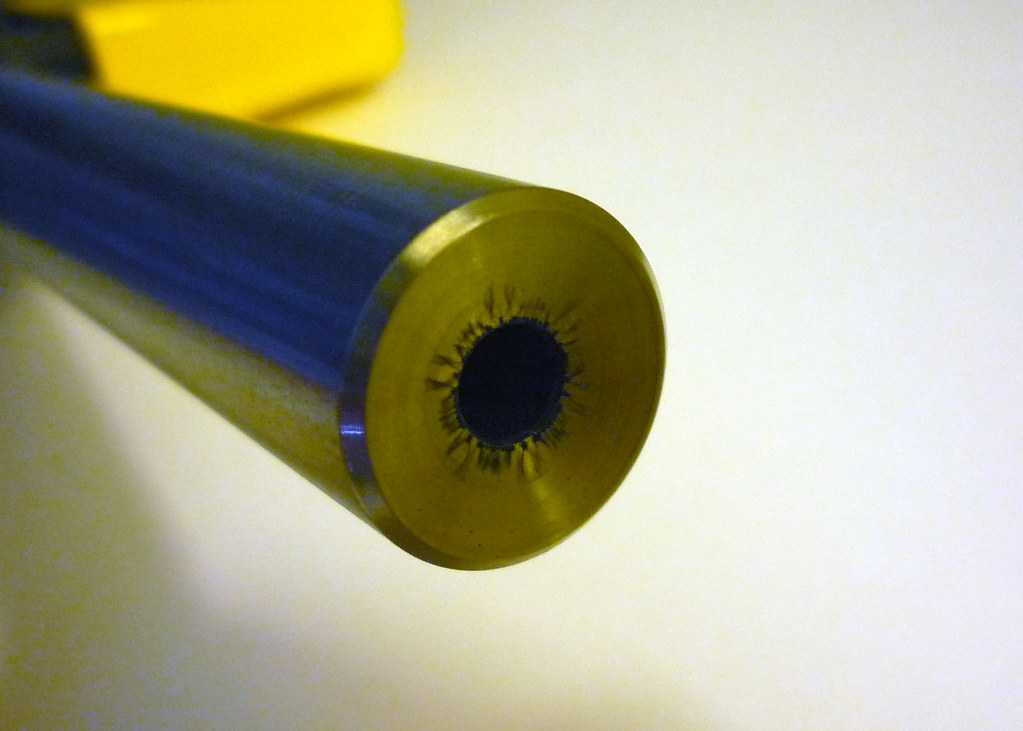
Now that's some rifling


Sick:


Hat tip: wikipedia http://en.wikipedia.org/wiki/File:105mm_tank_gun_Rifling.jpg

how to break a bull barrel python


I have a bull barrel python that has a big aristocrat rib on it, seemingly setup for PPC.

I thought that this meant it was fine for near max 357 mag loads. Unfortunately I was informed that PPC ribs were in fact designed to keep the front sight on the X ring when doing powder puff 38spl loads and using them for 357 was going to cause problems.

This is unfortunate since I only learned this useful fact after the rib flew off my gun tonight and whacked me on the head when shooting 357. The empirical record suggests that the rib is fairly heavy, in case you were wondering.

Here's how things should look:


And like magic, reality shows how they actually look:


Fixing misfires in a 41 mag python


[As always: this is just for entertainment purposes. If you do any of this t your gun it's going to get ruined! Note there are suggestions at the end of the post for things to do differently.]

I recently got a 41 mag python, which got dissected to see how Jack Huntington did the conversion (http://coltpython.blogspot.com/2009/07/forensic-photos-41-magnum-python-by.html). It had a lot of enshake which I fixed (http://coltpython.blogspot.com/2009/07/fixing-endshake-on-41-magnum-python.html). And while it didn't blow up after shooting a couple hundred rounds (http://coltpython.blogspot.com/2009/07/41-magnum-range-report-it-does-not-blow.html) it would also misfire about 1 round per cylinder.

The misfires were with large pistol CCI primers. I got told to just use federal, but that's cheating, so spent some time this weekend attempting to fix things.

The DA pull is around 6.2lbs, so it's possible that the mainspring is the problem. However, I've done colts that have a lighter pull and they've worked w/o issue, so the problem could be something else. Admittedly these other guns shoot 357, so perhaps the force needed to ignite small pistol primers is less than for large. However, I don't want to just blindly increase the mainspring as a way to mask any underlying issue.

To spare you the dynamic tension, in the end I did wind up increasing the mainspring by about 4oz but a lot of stuff got fixed along the way, so perhaps it's interesting anyway.

Just for reference here's the gun after the endshake fix:


A good colt smith gave a rundown of things to check for tracking down misfires, so we do some of those first.

Friday, July 17, 2009

making a 50bmg barrel.

Not super detailed, but interesting nonetheless: http://www.riflebarrels.com/articles/50calibre/chambering_50cal_rifle_barrels.htm

More Randy Lee on hammer mass and firing pins

http://smith-wessonforum.com/s-w-smithing/90499-my-thoughts-firing-pin-length-ignition.html

I need to track down the rest of his posts. But anyone that gets reliable guns at a DA pull of 3lbs needs to be paid attention to.

Hat tip: Paul D.

Thursday, July 16, 2009

WSJ picks of top econ blogs

http://online.wsj.com/article/SB124768581740247061.html

I'm slowly working my way through. Of the first few, this one seems the best: http://www.calculatedriskblog.com/

just got a emco (not enco) compact 5 CNC!


I just got an emco CNC compact 5. The good news is that the thing actually works, despite the cheap price. The bad news is that it's the first generation so doesn't even have a place to plug in a cable to the computer.

"Suboptimal" is a charitable view of this setup.

I can't seem to find a reasonable 3 jaw chuck so had to go with collets instead.

In relief news I was able to figure out most of the 12 simple (g code) commands it provides. The manual I have seems to be for the latter versions, so a bunch of stuff they do does not work on mine. Like deletion.

So now I can make it go back and forth, in circles, and other fairly rudimentary geometric shapes. Nothing that would make Euclid interested, but still.


Useful machining techniques.

Cute trick: stick drill chuck into lathe headstock to make poor man's collet holder. Surprisingly good runout.

http://www.astronomiainumbria.org/advanced_internet_files/meccanica/easyweb.easynet.co.uk/_chrish/techindx.htm

Followers